

Equity market as a retail playground backed by politicians and smart money
Financial markets continue to evolve, with sentiment playing an increasingly important role. Given that investing is a money-making machine, everyone wants to participate. Since the COVID-19 pandemic, markets have been increasingly influenced by retail investors, whose investment decisions are often susceptible to sentiment, Reddit posts, FinTwit commentary on AI bottlenecks, and, more recently, the buying and selling activity of politicians. As a result, we have seen the emergence of even “autopilots” tracking politicians’ trades, while the prices of certain stocks can jump after politicians disclose their transactions—as happened with Mastercard and Visa after Donald Trump revealed significant purchases in these companies.
It is understandable that, in an environment of complete uncertainty, everyone wants a guru to follow. But are these gurus right? Is there consistent evidence that following “smart money” or politicians’ trades can actually make you a successful investor?
In this article, we dive into the topic, looking at which external signals are worth following and which are more akin to PR and hype, signals that may quickly disappear, leaving a weak company in the portfolio after it was bought on a hyped-up buy signal from a politician or large investor. We focus on three relevant pillars: insider trades, large institutional investors, and politicians. The matter is complex, which may translate into ambiguous conclusions, but with a smart approach, these signals can provide excellent confirmation of a thesis based on fundamentals and valuation.
Insider trades
Insider trade is perhaps the most relevant signal with regard to future fundamental performance and much more reliable than blindly following “smart money.” Information asymmetry in financial markets is obvious, so investors naturally tend to track insider transactions. There are a number of studies indicating that insider selling does not necessarily signal a deterioration in future performance, as insiders sometimes need to cash out or exercise their options. However, when an insider sells a large proportion of their existing position, it is usually a negative signal1. Interestingly, smaller sales have been correlated with significantly positive subsequent returns.
Figure 1. Insiders buys as a positive trading signal
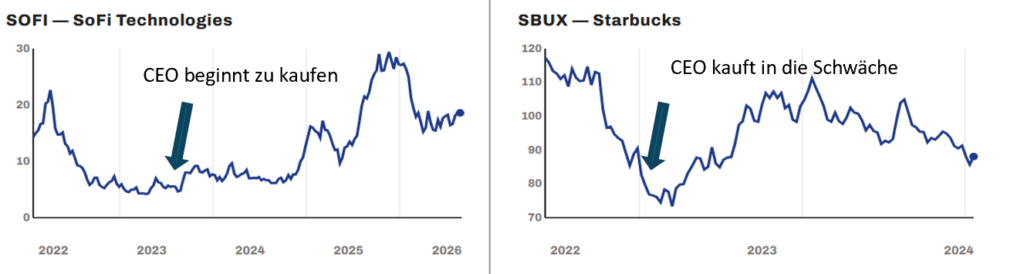
Surely, stock purchases by senior executives are relatively rare, but they are usually a positive signal with relatively strong predictive power, as illustrated in Figure 1. A Norwegian study found that executives below the top management level earn abnormal returns on purchases of their own-company stock: +84 bps after one month and +426 bps after six months2. Nevertheless, investors should still be careful and conduct their own research, as CEOs can also be wrong or may simply be demonstrating their confidence and loyalty to the company. For instance, Netflix’s CEO bought shares after subscriber growth disappointed in January 2022, but the stock continued to come under pressure. Similarly, Nike directors, including the famous Apple executive Tim Cook, and Nike’s CEO bought shares towards the end of 2025, yet the company continued to struggle amid serious structural challenges.
Large institutional investors
Not all institutional investors can be classified as “smart money,” so there is limited value in blindly following their trades, as the predictive power for abnormal returns is generally limited. According to recent academic research, however, several types of institutional activity do have meaningful predictive power for future abnormal returns.
Kirk indicates that institutional ownership exceeding the expected level based on predefined company characteristics can be a predictor of strong fundamentals and price momentum3. Koch finds evidence that, in general, mutual funds are not worth following blindly. Instead, attention should be devoted to “leader” funds—the first investors to trade, whose actions are subsequently followed by the rest of the mutual-fund cohort4.
Another study finds that extreme increases or decreases in institutional ownership predict subsequent abnormal returns around earnings announcements5. The effect is particularly strong when the change is driven by a relatively small number of institutions making disproportionately large trades. A perfect example was recently identified when screening 13-F filings for 2Q’26 new entries and exits: Veeva, a US software company serving the healthcare industry, where we had also initiated a position earlier. Veeva ranked No. 6 on the list of new institutional buys. The company subsequently reported excellent 2Q results, sending its share price up by 15%. Institutional money can therefore be informative, but “institutions are buying” is too broad a signal. Academic evidence suggests that the strongest predictive power comes from abnormal accumulation by a relatively small number of sophisticated investors, particularly when a skilled institution establishes a new, meaningful position or materially increases an existing one.
Politicians as traders
Following politicians’ stock-market trades as an investment signal became particularly popular after the widely publicised case of Nancy Pelosi buying Nvidia ahead of favourable developments around the CHIPS Act. However, the picture is not that simple, and overall, the predictive power of political trades appears to be much lower than that of insider and sophisticated institutional trades. The “Follow the Congress” rhetoric is unlikely to generate superior returns, as congressional trading appears to resemble uninformed retail trading rather than informed trading6. However, there is certain evidence that politicians sitting on relevant committees overseeing particular legal matters or responsible for industry-specific legislation can earn higher returns. A well-known example is Kelly Loeffler, who sold travel-related stocks and bought Citrix, extreme beneficiary during work form home era, following a private briefing on the development of COVID-19.
Implications for long-term investor
Summarising the trading signals provided by influential stakeholders—insiders, institutional investors, and politicians—based on the academic research, it can be argued that a number of signals have relatively strong predictive power, with insider transactions generally providing more reliable signals than institutional and political trades.
Table 1. Trade signals with highest predictive power (Source: AI based on academic research)
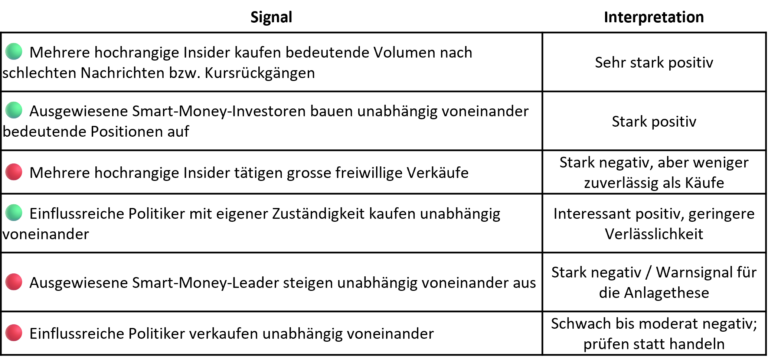
Surely, a positive trading signal in itself does not create an investment thesis for a long-term position. There are cases where even CEOs have been mistaken. However, such signals can provide valuable confirmation of an investment thesis based on fundamentals and valuation. A negative signal, on the other hand, should certainly trigger the siren and red lights and prompt investors to investigate whether some negative development has been overlooked. The objective is not to blindly follow the “smart money,” but to use these signals as an additional source of information when testing an investment thesis.
References
- Scott, J., & Xu, P. (2004). Some insider sales are positive signals. Financial Analysts Journal, 60(3), 44-51.
- Hvide, H. K., & Nielsen, K. M. (2026). Flying below the radar: Insider trading by executives below the top. Journal of Financial Economics, 181, 104282.
- Kirk, M. (2026). Abnormal Institutional Ownership and Expected Returns. Journal of Accounting, Auditing & Finance, 41(2), 524-546.
- Koch, A. (2017). Herd behavior and mutual fund performance. Management Science, 63(11), 3849-3873.
- Ali, A., Durtschi, C., Lev, B., & Trombley, M. (2004). Changes in institutional ownership and subsequent earnings announcement abnormal returns. Journal of Accounting, Auditing & Finance, 19(3), 221-248.
- Chen, H., & Sacerdote, B. (2026). Capital in the Capitol: Congressional Trades Resemble Uninformed Retail Trading (No. w35041). National Bureau of Economic Research.
ADVERTISEMENT
This document has been prepared solely for information and advertising purposes and does not constitute a solicitation offer or recommendation to buy or sell any investment product or to engage in any other transactions.