

When Debt Stops Being Abstract
A government can carry a large debt for years without a crisis. The pressure changes when investors begin to doubt that borrowing will be brought under control. France is now the clearest example in Europe: the question is not whether it can pay, but how much it will have to pay – and whether a divided parliament can agree on a plan to slow the growth of its debt.
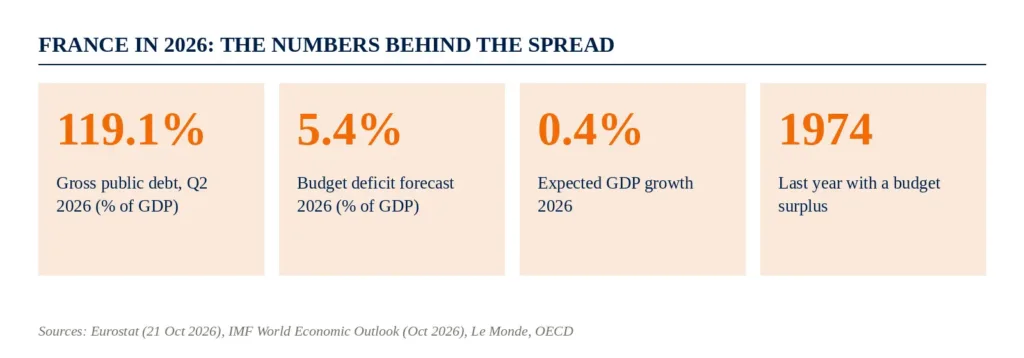
Public debt is high almost everywhere; the IMF puts it at 94.6% of global GDP in 2026. Yet markets still rank borrowers by growth, budget discipline, institutions and the ability to respond. France sits in a currency union, cannot set its own interest rates and has not recorded a budget surplus since 1974.
The bond market is pricing the doubt
On 22 October 2026, the extra yield investors demand to lend to France rather than Germany for ten years reached about 1.78 percentage points, up from roughly 0.80 in mid-August. The French 10-year yield briefly touched 5.14%. The next day Moody’s confirmed its Aa3 rating but kept the outlook negative – on the assumption that a deficit-reducing budget for 2027 will pass.
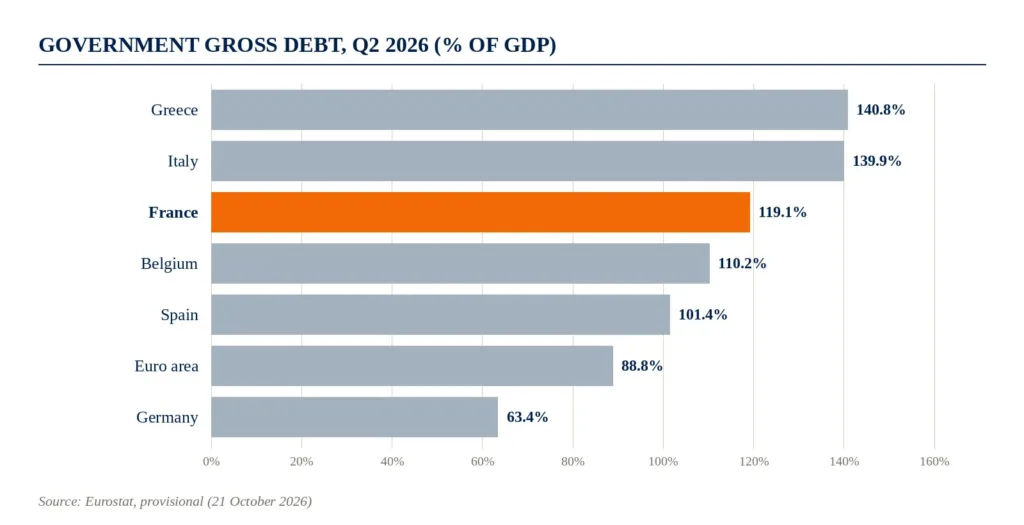
Greece has the highest debt ratio in the EU, yet it fell from 152.0% to 140.8% of GDP within a year. France’s rose from 115.4% to 119.1%. The level matters, but so does the direction: when the interest rate on existing debt exceeds nominal growth, a country needs a stronger primary balance just to stand still.
The ECB can contain disorderly market moves, but it cannot replace budget choices. Ultimately, France has to tackle its deficit through its own decisions on spending, revenue and growth.
Conclusion
High public debt does not automatically trigger a crisis. The decisive question is whether a government can maintain confidence in its ability to manage future deficits. The real cost of excessive debt is not only the interest paid today, but the freedom of action it takes away tomorrow.
ADVERTISEMENT
This document has been prepared solely for information and advertising purposes and does not constitute a solicitation offer or recommendation to buy or sell any investment product or to engage in any other transactions.