
When great companies underperform
Fantastic company, valuation clearly below its historical levels, growth continues at a good pace, but… it substantially lags behind the benchmark. One might immediately think of Microsoft, an excellent company, but it was underperforming the broad stock index, while clearly outperforming the software index. Or take Mastercard, with one of the best balance sheets and profitability levels we have ever seen, continuing to deliver double-digit growth rates despite fears of disruption risks. SAP is another victim of the SaaSpocalypse, though its business model is much more resilient than that of ServiceNow or Salesforce, the latter being an extreme case, as expensive CRM systems would be the first to be replaced by AI. The resilience is proved by the continuing delivery of strong results as well as a good forecast. The stock is down together with the software sector.
This paradox and potential for investment opportunities, to a great extent, is explained by sector sentiment, which is becoming increasingly important in the investment community due to the following factors: the growing popularity of passive investing and sector ETFs; algorithmic and factor-based strategies; faster information dissemination through digital platforms and social networks; and a stronger focus on thematic investment narratives.
The recent AI investment cycle is a good example. Large capital flows have been directed towards companies exposed to AI infrastructure, from semiconductor designers and manufacturing equipment to power infrastructure and data-centre-related businesses. In contrast, sectors with little direct exposure to the AI investment cycle have received considerably less investor attention.
The result is a market in which the sector environment can have a substantial influence on individual stock performance. If sector forces are becoming more powerful, are companies within the same sector also becoming more similar in their stock-market performance? Our analysis suggests that the answer is surprisingly no.
Sector trends create dispersion, not uniformity
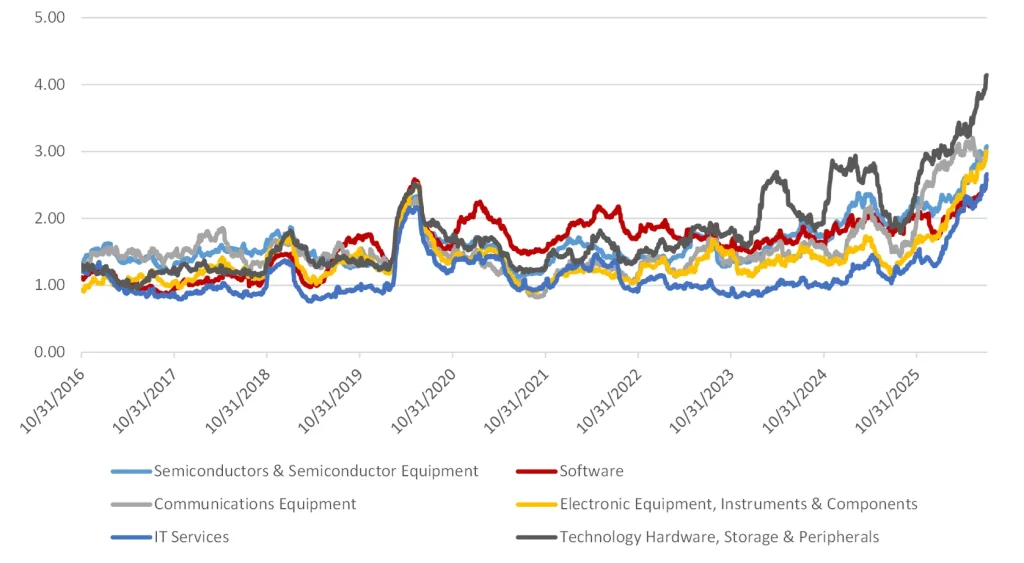
We analysed stock-return correlations within sectors to examine whether companies operating in the same industry are increasingly moving together. Contrary to our initial hypothesis, we discovered a striking development: increasing dispersion in stock returns within sectors. Especially strong dispersion has been seen in the IT sector, which has skyrocketed since mid-2025. This is not explained simply by a rotation between software and semiconductors, since dispersion has increased across all major IT industry groups. We saw increases in dispersion in all sectors, except Utilities, where it has traditionally been harder to differentiate between companies.
Figure 1. Daily Return Dispersion by Sector (3mo rolling avg), S&P 500, Aug16-Aug26
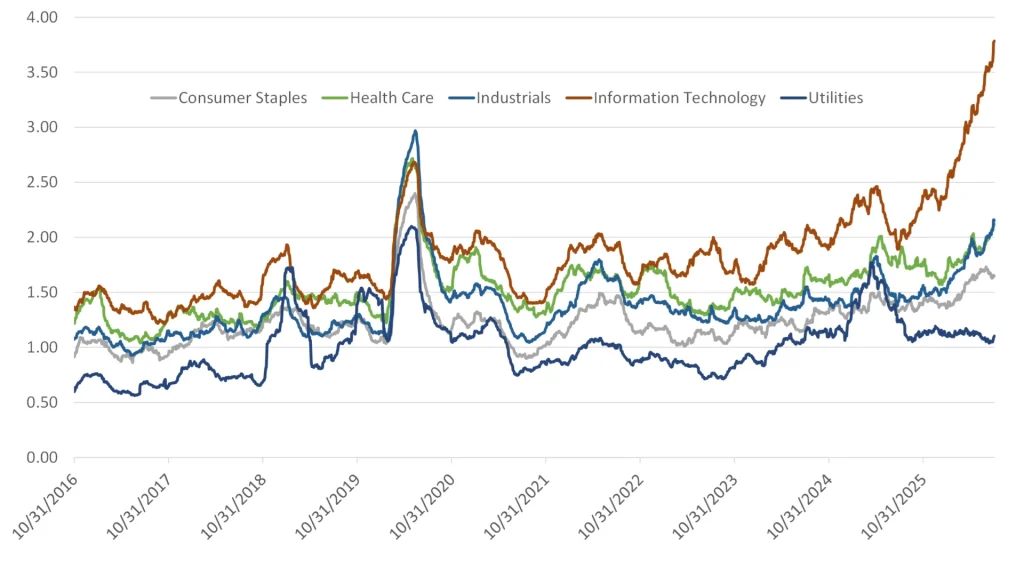
Figure 2. Daily Return Dispersion by IT Industry groups (3mo rolling avg), S&P 500, Aug16-Aug26
So, a sector can move strongly in one direction while individual companies within it produce very different returns. The same sector narrative can therefore create both winners and losers. The differentiation comes from differences in the quality of the companies: well-managed companies vs. poorly managed companies, stronger vs. weaker competitive positioning, and differences in switching costs, customer dependence and product criticality, even when companies are operating on the same playing field.
Does valuation matter?
Valuation always matters, but its importance changes depending on the market environment. During periods of strong sector momentum, investors are often willing to pay higher multiples because future growth expectations dominate current valuation concerns. Nvidia’s performance during the AI investment cycle is a good example. The company appeared expensive based on traditional valuation metrics, but extraordinary earnings growth exceeded even optimistic expectations.
On the other hand, good companies affected by negative sentiment can become significantly cheaper relative to their fundamental strength. German enterprise software developer SAP has been heavily sold off due to AI disruption fears, along with the broader software sector. Its valuation has compressed, with its P/E ratio declining to 23x, in line with the market average, and its PEG ratio declining to 1.44, clearly below the market average. The key question is whether the sector’s AI disruption narrative is justified for SAP specifically. So far, the company’s fundamental performance suggests significant resilience: business quality remains strong and the company continues to deliver robust growth, supported particularly by its booming cloud segment. At the same time, SAP’s enterprise software ecosystem is deeply embedded into critical business processes, creating significant switching costs and customer dependency.
Figure 3. German software SAP stock relative valuation vs. MSCI World
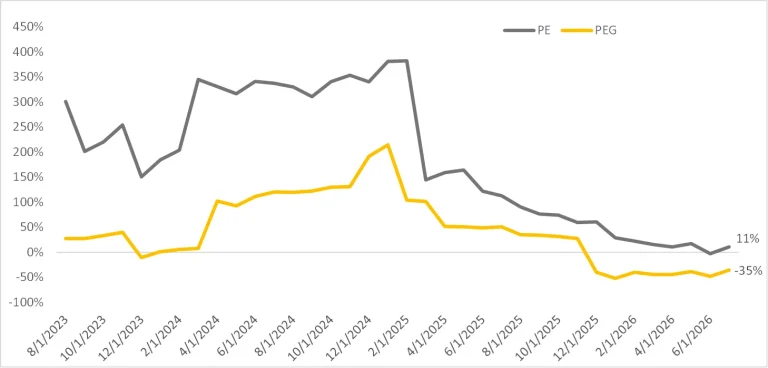
SAP illustrates the type of situation that can be particularly attractive for Quality investors: a strong business, temporarily affected by negative sector sentiment, while its valuation has compressed despite resilient fundamentals.
Opportunity for Active Quality investors
Sector dynamics have become an increasingly important driver of equity returns. However, our analysis shows that stronger sector influence does not necessarily lead to greater uniformity among companies. The combination of stronger sector influence and increasing dispersion within sectors creates an interesting environment for active investors. Sector trends increasingly determine the direction of capital flows and investor attention. But increasing dispersion means that these flows do not benefit all companies equally.
This creates three potential sources of investment opportunity: identifying attractive sectors early; identifying the winners within attractive sectors, where fundamental analysis becomes particularly valuable when the dispersion between companies is high; and identifying high-quality companies that are temporarily mispriced, when negative sector sentiment pushes down the valuations of fundamentally resilient businesses, allowing investors to acquire Quality at a discount. For Quality investors, the most attractive opportunities may arise when these three elements become temporarily disconnected: when a high-quality company operates in an unpopular sector, when a strong sector contains companies with very different fundamental prospects, or when valuation fails to reflect the durability of a company’s competitive advantages.
ADVERTISEMENT
This document has been prepared solely for information and advertising purposes and does not constitute a solicitation offer or recommendation to buy or sell any investment product or to engage in any other transactions.