

Taking pills during reporting season
Rising uncertainty and a rapidly changing market environment have been the key drivers behind increasing volatility in individual stock prices. This upward trend has become particularly visible in recent years. If Trump’s intentions to reduce corporate reporting to twice per year materialize, the reaction to each earnings release could become even more intense, potentially amplifying price swings further. During reporting season, it may even be reasonable for investors to mute notifications to avoid emotional overreactions.
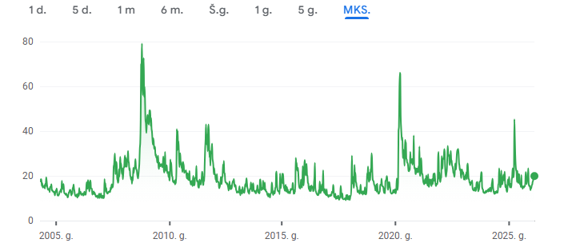
Interestingly, while individual stocks have become more volatile, broader market index volatility has remained relatively stable. Even when viewed over a longer historical period, broad market volatility has not changed significantly over the past decade (Fig.1) . According to Bloomberg, current level of individual stock volatility is at the levels we saw during dot-com bubble and financial crisis of 2007/08.
Figure 1. Chicago Board Options Exchange’s CBOE Volatility Index
To examine this “new normal” environment, we constructed historical volatility charts across sectors, investment styles (value vs. growth), and market capitalization buckets. Volatility was measured using a 20-day rolling calculation based on intraday price fluctuations. Our five-year sample includes periods of elevated market stress, such as the 2022 downturn and the April 2025 tariff announcements. While these episodes naturally show heightened cross-market correlation, our primary focus is on the underlying trends outside of extreme shock periods.
Sector factor
Volatility clearly differs across sectors. Real estate, communication services, and financials have traditionally exhibited higher volatility levels, but without any recent abnormal spikes. In contrast, healthcare, historically viewed as a defensive “safe haven”, has experienced a noticeable uptrend in volatility. Stock prices now react sharply to clinical trial results and regulatory updates, making the sector far more sensitive to company-specific news.
Figure 2. Stock price volatility by sectors, MSCI World
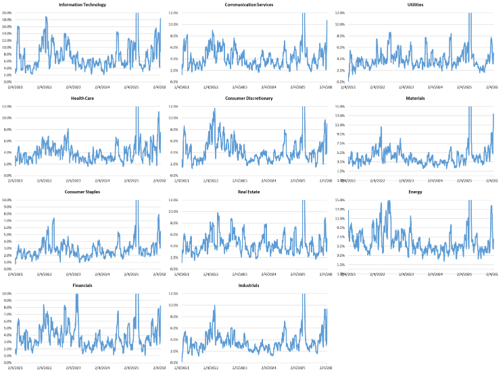
The IT sector showed declining volatility after the 2022 spike, but then it surged again in 2025. SaaS companies experienced heavy sell-offs, while chip-related stocks rallied sharply, creating strong internal dispersion within the sector. Industrials, historically characterized by relatively low volatility, also saw increased swings in 2025 as capital rotated from the Mag7 toward more cyclical and real-economy sectors.
Style factor
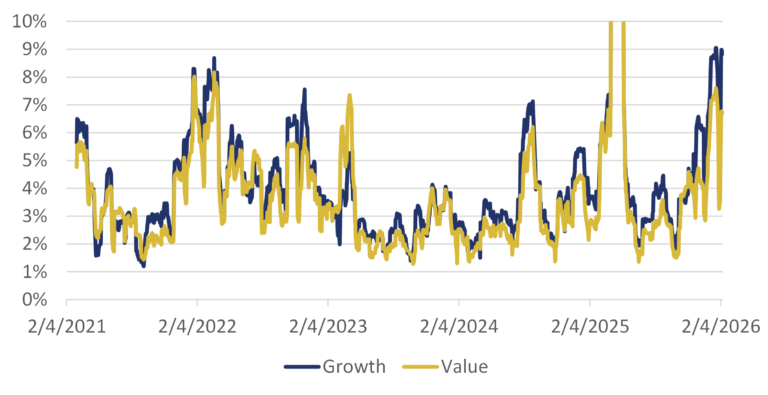
Applying the same methodology to value and growth stocks reveals no structural divergence in volatility patterns. There is a strong correlation between the two styles. However, during periods of elevated uncertainty, growth stocks tend to be more volatile. Overall, volatility shows an upward trend across both categories.
Figure 3. Stock price volatility by investment styles, MSCI World
Size factor
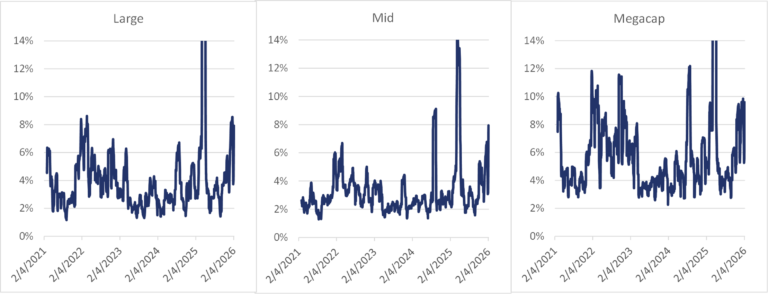
The most revealing results emerge when analyzing volatility by market capitalization. Historically, mega-cap stocks have exhibited the highest volatility, while mid-caps have shown the lowest. Although volatility in the mega-cap segment has remained consistently elevated, large- and mid-cap stocks have experienced a meaningful increase in volatility in recent periods.
Figure 4. Stock price volatility by market cap size, MSCI World
Portfolio risk management
Elevated volatility at the individual stock level has become a structural feature of today’s markets. Algorithmic trading, rapid information dissemination, geopolitical uncertainty, tighter financial conditions, and intensifying competition in all sectors amplify price swings, particularly around earnings and news events. Even historically stable sectors now react sharply, making volatility the new normal rather than an anomaly.
Managing risk in this environment requires a deliberate approach. Gradually building and scaling out positions can reduce exposure to sudden spikes especially during reporting season, while diversification across sectors, geographies, styles, and market caps smooths portfolio fluctuations. Disciplined position sizing, pre-defined exit rules, avoiding crowded trades, and focusing on companies with strong balance sheets help limit downside risk.
In today’s market, volatility creates both challenges and opportunities. Careful risk management and disciplined execution have become just as important as stock selection itself.
ADVERTISEMENT
This document has been prepared solely for information and advertising purposes and does not constitute a solicitation offer or recommendation to buy or sell any investment product or to engage in any other transactions.