

AI- and data-centre-exposed stocks have come under pressure as investors question whether massive infrastructure spending will translate into sufficient returns. UBS estimates that potential construction delays could put around 30% of planned US data-centre capacity additions in 2028 at risk1. Beyond near-term spending concerns, a bigger question remains: will AI investments deliver the productivity gains and earnings growth needed to justify today’s valuations? In this article, we look at AI though investor’s lens at valuations, profitability, financing, the implications for Quality investing.
In the end, bubble or not?
Investors are reminded almost daily that an AI bubble may be forming. But can a bubble develop when expectations are being scrutinised so closely? Awareness of the risks does not necessarily prevent excess, particularly when the fear of missing out becomes stronger than the fear of losing money. At times this year, valuations appeared stretched and market enthusiasm approached euphoria. Investors’ fear of missing out has been reinforced by corporate FOMO: companies feel compelled to invest in AI for fear of being overtaken by competitors.
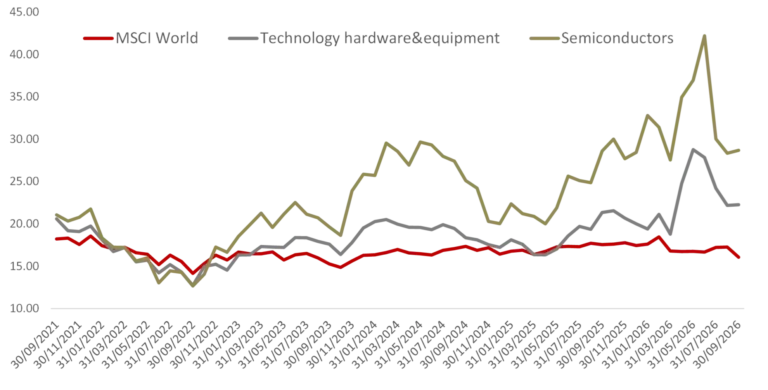
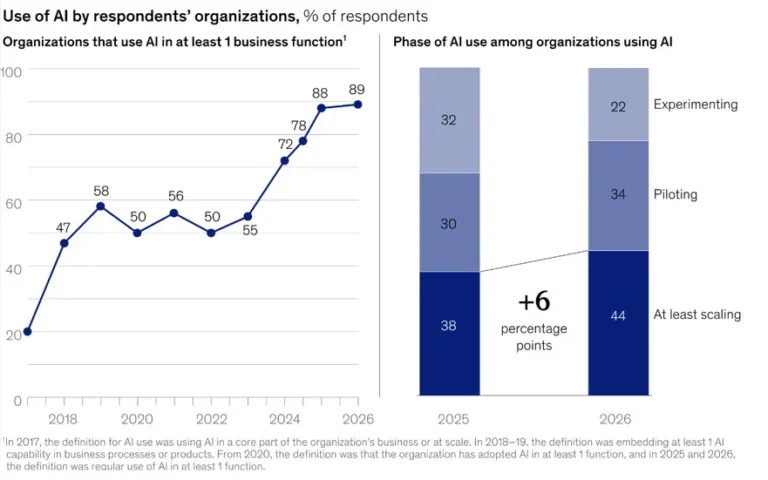
Since the middle of the summer valuations have corrected significantly, moving closer to historical averages, though we are still in the early stages of a technological transformation that could deliver substantial productivity gains. McKinsey’s 2026 survey provides an interesting reality check. Around 80% of respondents reported improvements in personal productivity, while 37% attributed at least some enterprise-level earnings impact to AI2. Yet only 6% qualified as AI high performers under McKinsey’s definition. The gap between individual productivity improvements and measurable corporate financial benefits remains substantial. There is also a difference between expectations and reality in the labour market. While 32% of respondents expected AI to reduce employment, only 14% had witnessed such a reduction. This is hardly surprising given that more than half of companies remain in the testing or piloting stages.
Productivity into profits
The key question is how companies will convert productivity improvements into sustainable profits. Recent announcements suggest that businesses are increasingly willing to restructure their workforces as AI adoption accelerates. Block announced cuts of more than 4,000 jobs (around 40% of its workforce), Meta approximately 8,000 (around 10%), and Barclays around 5,000 (approximately 5%). Microsoft, meanwhile, offered voluntary exit packages to a significant group of employees, with around 27% of its workforce eligible to participate. This trend could accelerate as companies move from experimentation and piloting towards broader implementation. The greatest potential for profitability improvements may lie in industries with large workforces and significant opportunities to automate repetitive processes, including financial services, software, healthcare, retail and logistics.
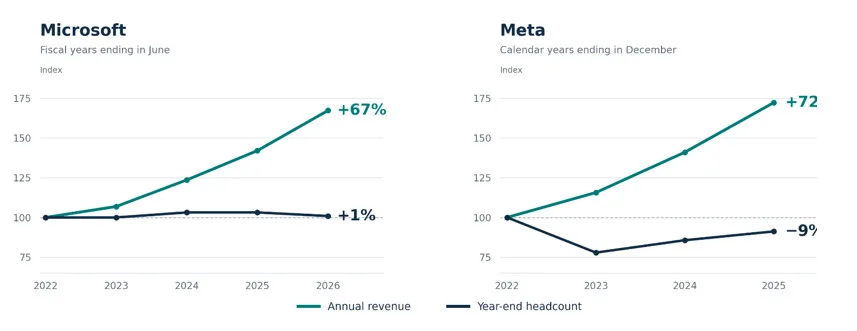
A recent Financial Times analysis highlights an interesting divergence: productivity is rising while employment is falling in the US technology sector, whereas the pattern is considerably weaker elsewhere3. However, much of this divergence started in 2022, making it difficult to isolate AI’s contribution from post-pandemic overhiring, higher interest rates and subsequent restructuring. Meta and Microsoft provide good examples of how companies can continue growing their top lines without a corresponding increase in headcount.
Who Finances the AI Race?
Financing is perhaps the most fragile part of the AI investment ecosystem, particularly if eventual returns fall short of expectations. Suppliers help finance customers who, in turn, commit to purchasing their chips and computing capacity. This creates a risk that financing and demand become increasingly dependent on each other. The amounts involved are mind-boggling. Just 14 AI-related transactions involve approximately $950bn in equity and debt financing – roughly 90% of Switzerland’s annual GDP. The $1.4trn in future revenue commitments attached to these deals exceeds the Netherlands’ annual GDP of approximately $1.33trn. Financing on the scale of national economies is concentrated in a relatively small number of commercial relationships.
An important test of the economics comes from companies such as Anthropic, which has disclosed financial information ahead of its anticipated IPO. Its revenue has grown approximately 14.7 times, while computing and infrastructure expenses have increased fourfold. Demand has also broadened considerably: the number of customers generating more than $100,000 in trailing annual revenue increased from approximately 950 to 11,900 between September 2025 and September 2026. These figures provide encouraging evidence of genuine customer demand and improving operating economics. However, one company cannot validate the entire AI investment ecosystem, sustainability of earnings remains to be tested.
Putting Quality to the Test
For quality investors, the AI boom strengthens the case for selective stock picking and valuation discipline. The technology’s benefits may spread widely, while investment returns concentrate in businesses that can retain those benefits through pricing power, customer loyalty and efficient execution. Revenue growth becomes more convincing when it produces cash after computing costs, equipment replacement and financing obligations. Strong balance sheets, key characteristics of Quality firms, provide room to absorb a slower payback, but capital allocation still matters: even an excellent business can overbuild, like Google CEO saying that risk of overinvestments outweighs the risk of underinvestment. Opportunities also extend beyond infrastructure suppliers to established companies using AI to lower costs and strengthen already profitable franchises. The investment test is therefore whether AI improves a company’s competitive position and returns on capital, meaning basically strong corporate governance, and how much of that improvement the share price already assumes. Quality at an attractive valuation means participating in the opportunity while leaving room for the future to be less spectacular than promised
References
- https://www.reuters.com/legal/legalindustry/companies-most-exposed-potential-us-data-center-curbs-after-blue-sweep-2026-11-05
- https://www.mckinsey.com/capabilities/quantumblack/our-insights/the-state-of-ai
- https://www.ft.com/content/7f27aa5f-5994-4f82-aed8-1cade18fb487?utm_source=chatgpt.com&syn-25a6b1a6=1
ADVERTISEMENT
This document has been prepared solely for information and advertising purposes and does not constitute a solicitation offer or recommendation to buy or sell any investment product or to engage in any other transactions.