

Approaching 2027, most investors can recite the AI supply chain by heart: chipmakers, electricity providers, data centers and cooling systems. It has become the default way to invest in AI because the logic is straightforward. You do not need to predict which AI application will win. You only need to believe that all those applications will require computing power. So far, that part of the story is working. Nvidia’s order books, the hyperscaler’s capex plans and the construction of new data centers are backed by real money already being spent. But building the infrastructure is only half the equation. The harder question is whether the applications running on it will earn enough money to justify the investment.
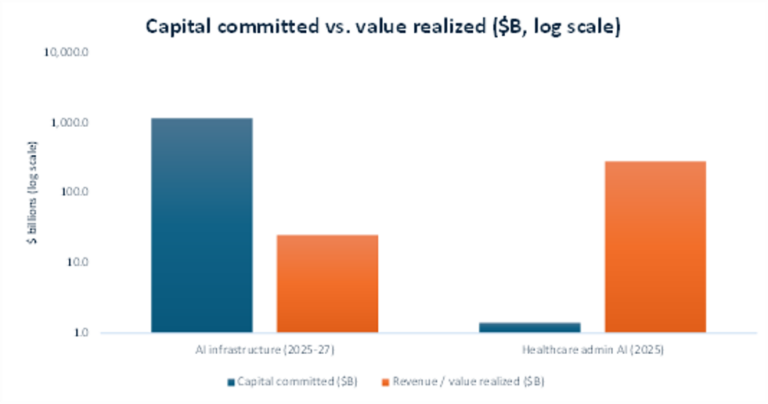
The shovels are selling. Whether anyone is finding gold with them is still largely a bet on the future. Healthcare is one of the few sectors where the answer is beginning to emerge—not in distant forecasts, but in results investors can measure today.
Figure 1. Capital committed vs. value realized ($Bn, log scale)
The size of the itch
Doctors spend up to 19 hours a week on administrative work, including writing notes, seeking approval from insurers, handling bills and answering messages1. For every hour spent treating patients, they can spend another two hours on electronic records and paperwork. One study found that a routine 30-minute appointment creates 36 minutes of work on the hospital’s computer system. Six of those minutes are completed after 5:30 p.m. Doctors call this “pajama time”: the evening hours spent finishing records at home2. Obtaining approval from insurers creates another burden. The average physician handles 43 approval requests a week, requiring about 12 hours of staff time in total. The human cost is clear. The financial cost is just as striking. McKinsey and the National Bureau of Economic Research estimate that AI could save the US healthcare system $200–360 billion a year by automating this work3. That figure represents an existing inefficiency, not a market that must first be invented.
For investors, healthcare AI is not one single opportunity. It is several different markets, each moving at a different speed.
Now, Next and Not yet: commercial timeline
Figure 2. AI maturity ladder in Healthcare

Today, the clearest returns come from paperwork and payments. AI note-taking tools are reducing documentation time by 50–70%, while 63% of healthcare organizations already use AI to check claims and anticipate payment problems. US spending in this category nearly tripled to $1.4 billion in 2025 4.
The next opportunity is clinical trials, where recruitment delays can cost as much as $8 million a day. TrialGPT, which matches patients with suitable studies, achieved 87% accuracy while cutting screening time by more than 40%⁵. Meaningful profits could follow within one to three years. Further out, AI can already interpret medical images, but insurers still lack standard ways to pay for most of these tools. Drug discovery is more distant still: it could create $50–70 billion in annual value by 2030, yet no fully AI-discovered drug has reached approval.
The timeline is therefore clear: administrative AI is producing measurable value now; clinical trials may follow next; diagnostics depend on reimbursement; and drug discovery remains the high-risk, high-potential end of the market. In a sector crowded with future promises, investors should distinguish between savings already being captured and breakthroughs still waiting to be proved.
AI-native vs AI-retrofitted
The more interesting investment question is no longer whether healthcare AI is real. It is who captures the value: younger companies built around AI from the beginning or established companies adding AI to systems their customers already depend on.
SOPHiA Genetics (SOPH:NASDAQ) represents the first group. Its cloud platform combines genetic, medical-imaging and clinical data to help doctors select more precise cancer treatments. Its advantage grows with use: the company has analyzed more than 2.3 million genetic profiles and serves over 537 institutions across 75 countries. Customer loyalty is strong. Existing customers are spending about 17% more each year, while fewer than 1% leave annually. Revenue rose 27% to $23.3 million in the second quarter of 2026, prompting management to raise its full-year forecast to $94–96 million. But SOPHiA still lost $22.4 million in the quarter. That captures the appeal and risk of companies built around AI: growth can be powerful, but there is little room for delays or disappointment.
Veeva Systems (VEEV:NYSE), on the other hand, is a durable quality company with an AI overlay, and is, perhaps, more interesting one for risk-conscious investors. Its software already manages essential work across the pharmaceutical industry, including research, clinical trials, regulatory filings and quality control. These systems are deeply embedded in customers’ daily operations and are difficult to replace. That’s the moat: AI works best when it has access to large amounts of organized, industry-specific data—and Veeva already manages much of that data. It can add practical AI tools, such as automating drug-safety reports, directly to software customers already use and pay for. Management believes Veeva’s AI could improve efficiency across the life-sciences industry by 15% by 2030. Meanwhile, the existing business generated $3.2 billion of revenue in its 2026 financial year, up 16%, with recurring subscription revenue rising 17%.
Figure 3. Growth vs Earnings Power. Sophia vs Veeva, 2026-2030E.
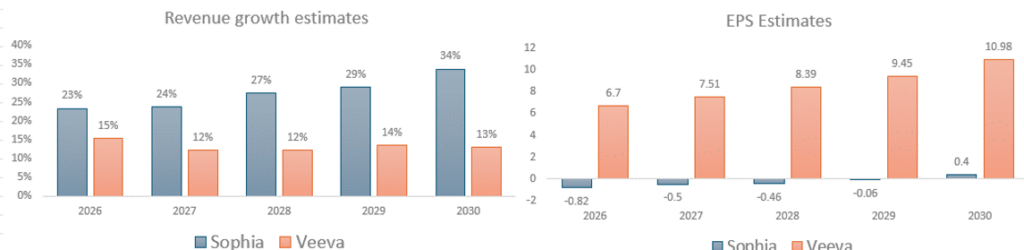
SOPHiA offers greater exposure to the success of healthcare AI, but also greater risk as AI-native growth is the entire investment case. Veeva’s AI exposure adds a call option on top of an already-compounding, high-ROIC, debt-free business — rather than being the thing an investor is underwriting. Both can work. But they sit on opposite ends of the risk spectrum a quality investor cares about: one is compounding profitably while it waits for AI to add on top, the other is betting that AI adoption arrives before the cash runs out.
References
- BillingParadise (2026). The state of medical billing in 2025: Key Challenges facing Healthcare Providers.
- Rotenstein, L.,Holmgren, A.Jay, et.al (2023). System-level factors and Time Spent on Electronic Health records by Primary care Physicians. JAMA Netw Open, 2023;6;(11):e2344713.
- Mckinsey & Company (2023). Setting the revenue cycle up for success in automation and AI.
- Melno Ventures (2025). 2025 State of Healthcare AI Report.
- Jin, Q., Wang, Z., Floudas, C.S., et al. (2024). “Matching patients to clinical trials with large language models.” Nature Communications, 15, 9074. DOI: 10.1038/s41467-024-53081-z.
ADVERTISEMENT
This document has been prepared solely for information and advertising purposes and does not constitute a solicitation offer or recommendation to buy or sell any investment product or to engage in any other transactions.