

The price of Quality
There are two questions in investing that are easy to confuse: is this a great company? And: is this a great investment at today’s price? Quality investors naturally focus on the first. But no one buys durable competitive advantages, high returns on capital or recurring cash flows in isolation – they buy them at a price. And that price already contains assumptions about future growth, margins and, perhaps most importantly, how long exceptional economics can persist.
A company can therefore keep performing well while its shareholders experience disappointing returns. The business does not have to fail. Sometimes it merely has to perform less exceptionally than the price assumed.
Adobe key figures 2021–2026
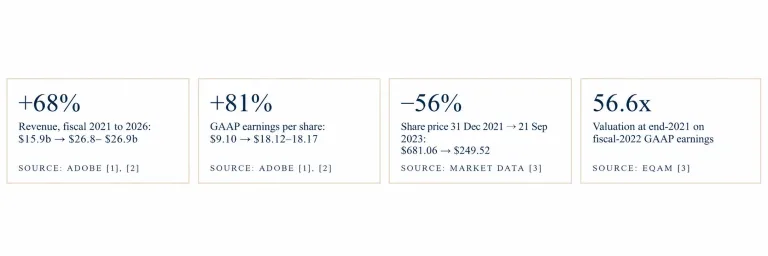
The business grew. The investment shrank.
Adobe is a striking recent example. In fiscal 2021 it looked like the textbook definition of a Quality company: category leadership, subscription revenues, gross margins of around 88%. At the end of 2021, the stock traded at roughly 57 times GAAP earnings. Under the fiscal-2026 targets raised in September 2026, revenue will have risen by roughly 68% since then and earnings per share by roughly 81%. Yet on 21 September 2026 the share price stood about 56% below its 2021 year-end close.
What did Adobe’s price require? Annual EPS growth needed for a 10% return, by exit multiple
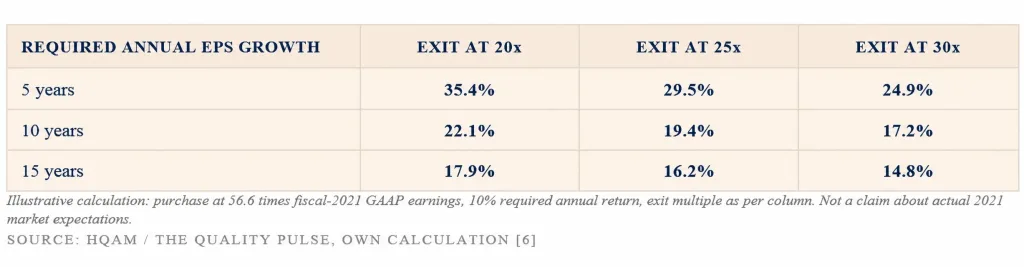
A multiple is not a valuation thesis – it is the consequence of one. At sufficiently high valuations, duration becomes part of the bet: what Mauboussin and Callahan call the Competitive Advantage Period. Adobe’s moat did not have to disappear for its valuation to fall; its expected duration merely had to shorten.
Conclusion
Quality deserves a premium – but not an unlimited one. As at 31 August 2026, the forward-earnings premium of Quality indices over MSCI World ranged from virtually zero to around 18%, depending on methodology. That does not make Quality cheap. It means valuation discipline must work in both directions: protect against excessive expectations when the premium is large, and recognise opportunity when superior economics are available at a reasonable price.
Quality determines how much value a company can create. Duration determines how long it can create it. Price determines how much of that value is left for the investor.
Download the full Quality Pulse as a PDF
ADVERTISEMENT
This document has been prepared solely for information and advertising purposes and does not constitute a solicitation offer or recommendation to buy or sell any investment product or to engage in any other transactions.