
1H 2026 Review
AI capex super cycle shines, shrugging off oil crisis
Unrest in Iran had been mounting since the beginning of the year. Expectations of escalating tensions were reflected in steadily rising oil prices, which supported the rally in oil producers’ share prices. Following the outbreak of the US-Iran conflict in February, financial markets closely monitored developments and reacted accordingly to any easing or escalation of tensions.
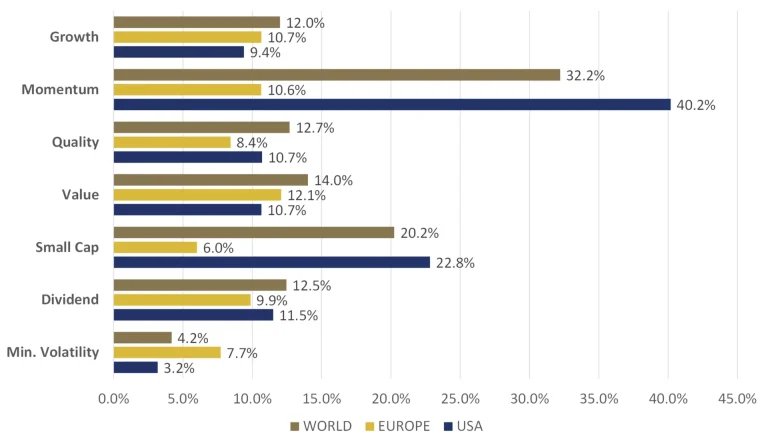
The blockade of the Strait of Hormuz affected not only oil prices but also the supply of several other critical commodities, with the greatest impact on jet fuel, fertilizers, sulphur, aluminium, and related products. As a result, the share prices of producers unaffected by the disruption rose significantly. Given that most of these companies are classified as value stocks, this provided strong support for value indices globally. The MSCI World Value Index returned 14% in EUR, broadly in line with the MSCI World Growth Index, which gained 12%. The absolute leader among styles indices was MSCI USA Momentum with 40% return strongly supported by AI capex cycle.
The disruption in the Strait of Hormuz has also fueled inflationary pressures, prompting central banks to adopt a more hawkish stance, with markets increasingly pricing in the possibility of further interest rate hikes.
Regarding sector performance in the first half of 2026, the strongest returns were generated by AI-related sectors, spanning the entire value chain rather than being limited to semiconductor companies. This broad-based strength helped global equity markets reach new all-time highs during the period. Additional support came from energy and metals companies, as supply chain disruptions boosted commodity prices and benefited producers. In Europe, banks were among the strongest performers. As a sector with a pronounced value bias, their performance contributed to the outperformance of the European Value index.
Quality was not among the best-performing investment styles. The style continues to have a significant overweight exposure to software companies, many of which remain under pressure from AI-driven disruption (discussed in more detail in the final section of this report). Although Quality indices also benefited from meaningful exposure to AI-related stocks, this was not sufficient to offset weakness in the software segment.
As a result, stock selection within the Quality style has become increasingly important. Investors should carefully assess company-specific risks and the potential impact of AI-driven disruption when evaluating Quality-oriented investments.
Fig.1. Total return for 2026 by regions based on MSCI regional indices (Currencies: USA – in USD, EU – in EUR, World – in EUR)
The full half-year report is available via the link below.
ADVERTISING
This article has been prepared solely for information and advertising purposes and constitutes neither a solicitation nor an offer or recommendation to buy or sell any investment instruments or to engage in any other transactions.